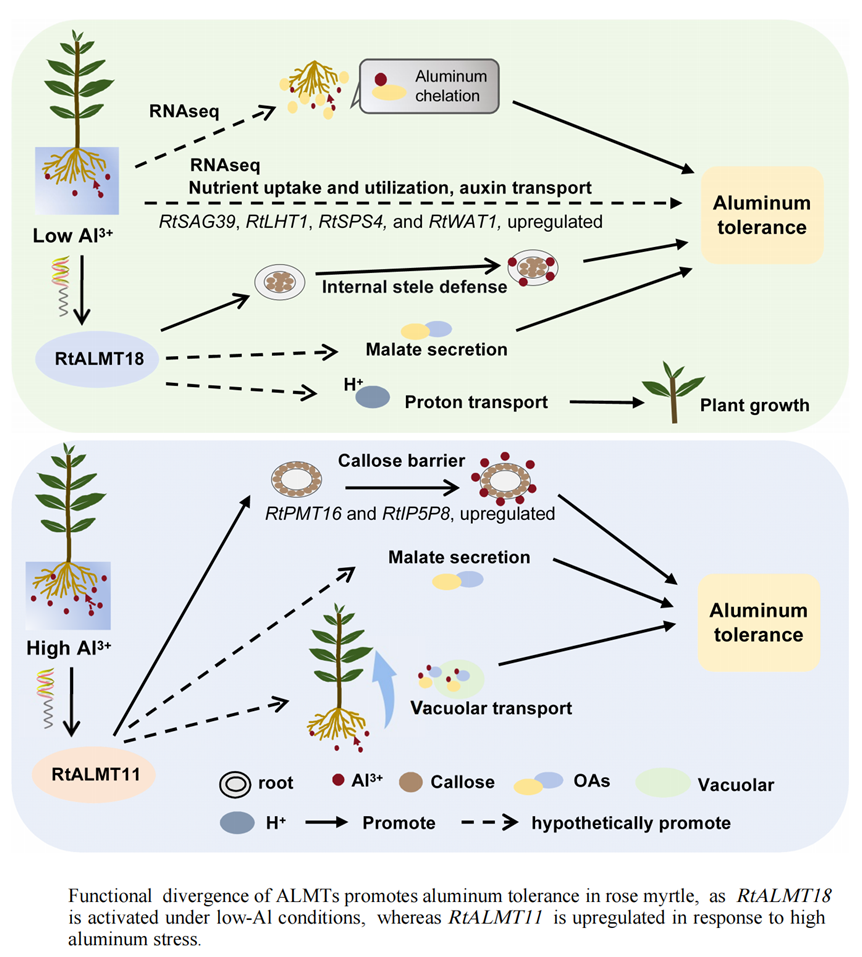
Acidic soils, accounting for over 50% of global potential cultivable land and serving as the core matrix for agricultural production in southern China, release soluble aluminum ions (Al³⁺) that damage plant roots and limit crop growth. Notably, Rhodomyrtus tomentosa (rose myrtle) not only tolerates high-aluminum environments but also uses low aluminum concentrations to promote its growth, a "harm-to-benefit" trait whose molecular basis has long intrigued researchers.
Recently, Professor Shulin Deng’s team from the South China Botanical Garden, Chinese Academy of Sciences, published a study in the prestigious journal Plant Physiology (entitled Functional divergence of ALMTs mediates organic acid transport and callose synthesis for aluminum tolerance in rose myrtle). The research systematically deciphers the dual molecular mechanisms enabling R. tomentosa to adapt to aluminum stress and achieve aluminum-promoted growth.
Focusing on the plant’s aluminum-responsive pathways, the team identified significant functional divergence between two key genes—RtALMT11 and RtALMT18—from the aluminum-activated malate transporter (ALMT) family. At the systems biology level, this divergence underpins precise regulation of aluminum responses: RtALMT11 mediates a canonical passive defense by secreting malic acid to chelate rhizosphere Al³⁺ and reduce toxicity; RtALMT18, by contrast, evolves constitutive expression to regulate cell wall callose synthesis and growth signaling pathways, realizing dual functions of aluminum tolerance and growth promotion as an active adaptive strategy. This differentiation allows R. tomentosa to thrive in both low- and high-aluminum acidic soils by switching between growth promotion and stress defense.
The findings carry substantial theoretical and applied value. Theoretically, they enrich the molecular framework of plant aluminum tolerance and promotion, offering new insights for evolutionary biology studies on plant stress adaptation and opening up novel avenues for ALMT family functional evolution research. For applications, the dual-function gene RtALMT18 provides elite genetic resources for crop molecular breeding. Introducing RtALMT18 into staple crops like rice and maize via gene editing or transgenic technologies holds promise for developing high-yield, acid-tolerant varieties, boosting agricultural productivity in southern China’s acidic soil regions. Additionally, the research lays a theoretical and technical foundation for acidic soil ecological remediation, supporting sustainable agricultural ecosystem development.
Dr. Ling Yang, former postdoctoral fellow at the South China Botanical Garden, is the first author, with Professor Shulin Deng as corresponding author. The work was supported by the National Natural Science Foundation of China, Guangdong Forestry Science and Technology Innovation Project, and Guangdong Science and Technology Plan Project.